Insights ·
SISTRIX AI citation study: 96,418 URLs show which page features matter
The short version
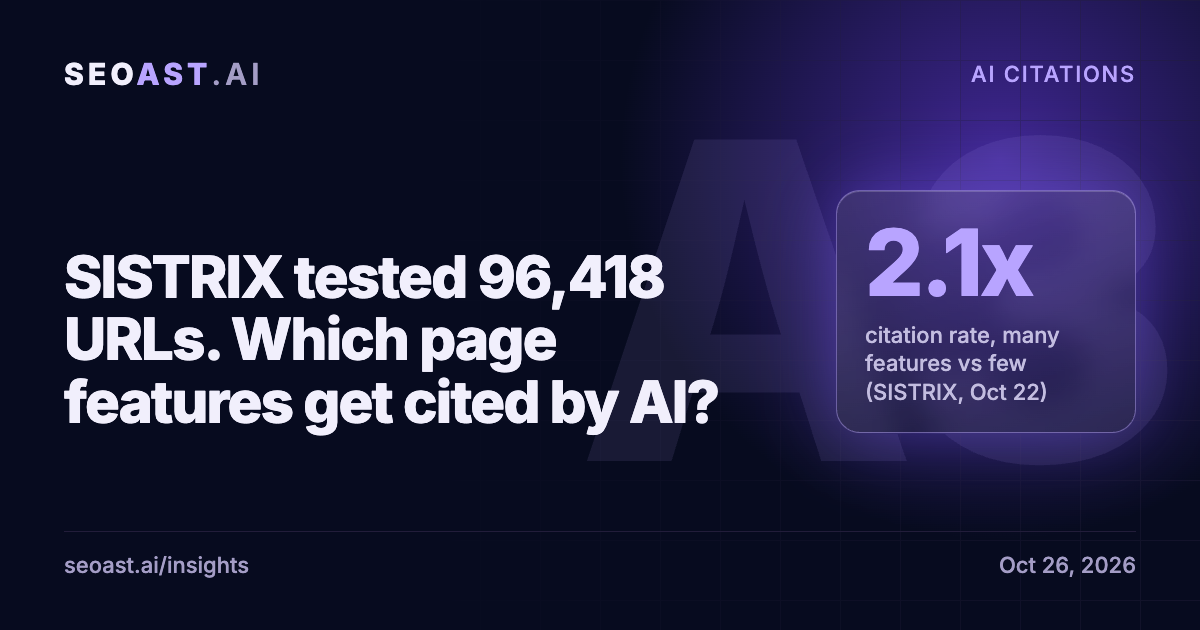
The SISTRIX AI citation study, published October 22, 2026, compared pages that ChatGPT, Google AI Mode and Google AI Overviews cited with uncited pages from the same domains, across 96,418 URLs. Pages with a table of contents, Article schema, five or more H2 headings, genuine FAQ markup, header-row tables and a visible update date were cited more often, and pages meeting many such features were cited 2.1 times as often as barely optimised ones. llms.txt, Flesch readability and Breadcrumb, HowTo or QAPage schema showed no measurable advantage. This is vendor data from the German-speaking market and shows correlation, not cause, but it gives site owners a concrete page-level checklist.
What the SISTRIX AI citation study measured
SISTRIX published “Citation Worthiness: Which GEO Tactics Hold Up Across 96,418 URLs” on October 22, 2026. The team took 48,527 pages cited in its AI Index for the DACH region (Germany, Austria and Switzerland) in the second quarter of 2026, about 16,000 each from ChatGPT, Google AI Mode and Google AI Overviews. Each cited page was paired with a page from the same domain that was not cited, which holds domain and brand strength constant. In total the study covers 96,418 URLs from 17,380 domains, scored on 43 features.
The results are reported as factors. A factor of 1.7 means that, of two pages on the same domain, the page with the feature was cited 1.7 times as often; 1.0 means no difference. SISTRIX used conditional logistic regression with a correction for multiple testing, and says the factors are technically odds ratios that are close to frequency ratios at a citation rate of about 1.4%.
SEOAST Impact Rating: A3, good to know. This is vendor data showing correlation, not a confirmed change by OpenAI or Google, and it covers one region. The Impact Rating is SEOAST’s own editorial rating, not a Google severity level.
Which page features were cited more often?
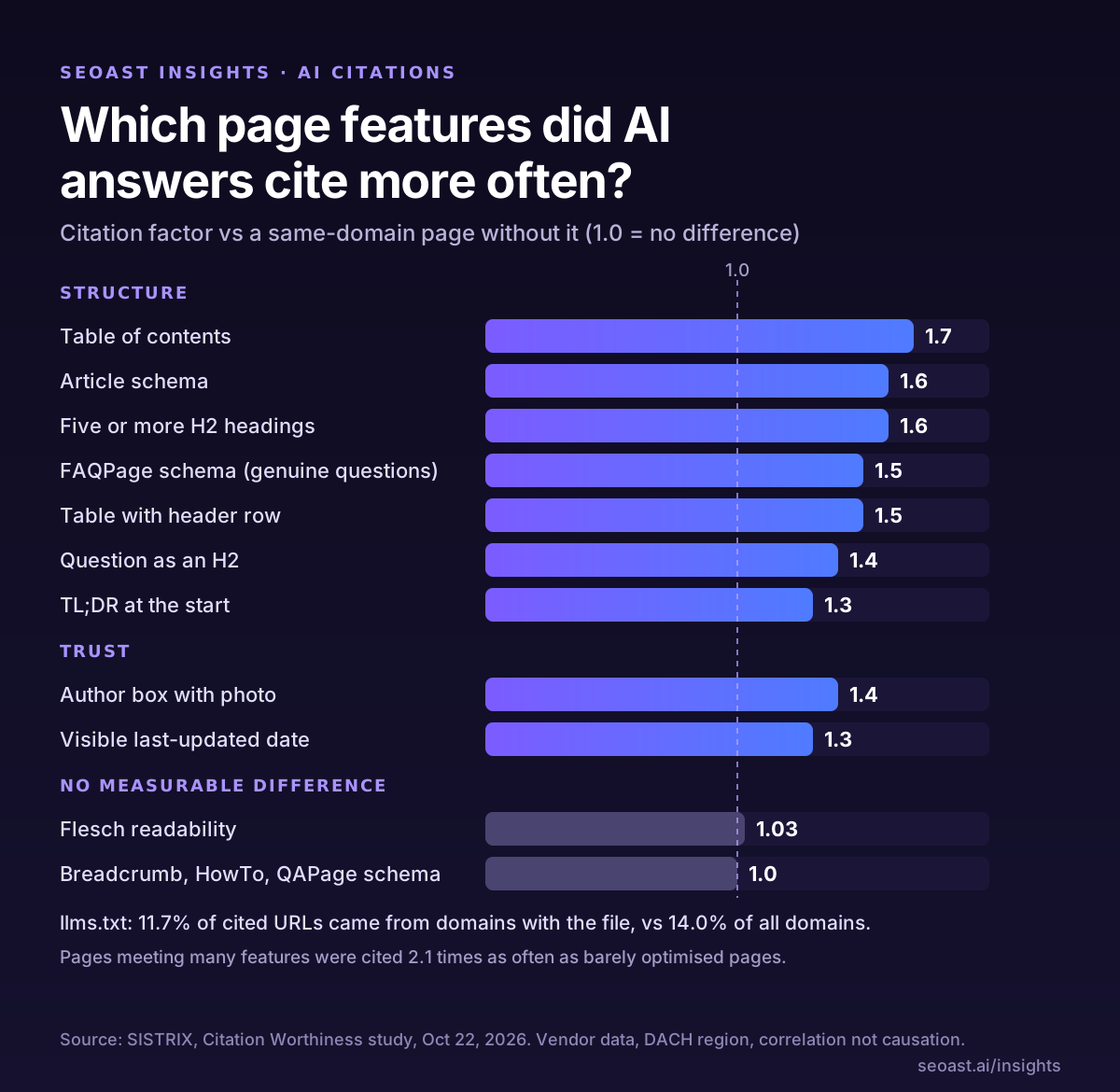
Structure stood out. A table of contents had the strongest structural factor at 1.7, yet only 14% of pages had one. Article schema and at least five H2 headings each scored 1.6. FAQPage schema scored 1.5, with SISTRIX stressing that the prerequisite is genuine questions rather than token FAQs. A table with a header row and ten or more bullet lists each scored 1.5, a question as an H2 1.4, and a TL;DR at the start 1.3. Pages of at least 1,000 words scored 1.5, which the authors attribute mostly to better structure rather than length itself.
Trust signals followed. An author box with a photo scored 1.4. A visible last-updated date scored 1.3, although only 5% of pages showed one. At least ten external links and at least three schema types each scored 1.3. The study also found that a current year in the title scored 2.7 and a title phrased as a question 1.3, but SISTRIX labels the title findings initial indications and notes they do not show whether simply changing the year helps.
Taken together, pages meeting many of the features were cited 2.1 times as often as barely optimised pages, and only 10% of cited pages already met many of them.
What did not matter: llms.txt, readability and some schema types
llms.txt showed no measurable advantage. Of the cited URLs, 11.7% came from domains with an llms.txt file, against 14.0% across all domains. Flesch readability scored 1.03 and was not significant. Breadcrumb, HowTo and QAPage schema scored 1.0. Product schema scored 0.8 overall, and Recipe schema 0.1, which the authors suspect reflects a preference for topic pages but have not tested.
SISTRIX also warns against small samples. In its own test runs, the measured effect of FAQ schema swung from negative at 833 URLs to positive at 4,600 and 96,418, so it recommends trusting only studies built on at least about 5,000 URLs.
How ChatGPT, AI Mode and AI Overviews differed
ChatGPT favored question-style titles (1.9), tables with header rows (1.8) and question H2s (1.6). Google AI Mode rewarded basics such as a table of contents or five or more H2s (1.8 each). In Google AI Overviews, Article schema scored 2.0, while product pages were about half as likely to be cited (0.5).
Site type mattered too. Editorial sites responded strongly to a table of contents (2.5). For online shops, a visible update date and Product schema were linked to fewer citations (0.7 and 0.6), so the checklist below is written for editorial and informational pages.
What to check on your pages this week
None of these requires a new tool, and each is good page hygiene regardless of AI answers. Treat the factors as correlations from one market, not guarantees.
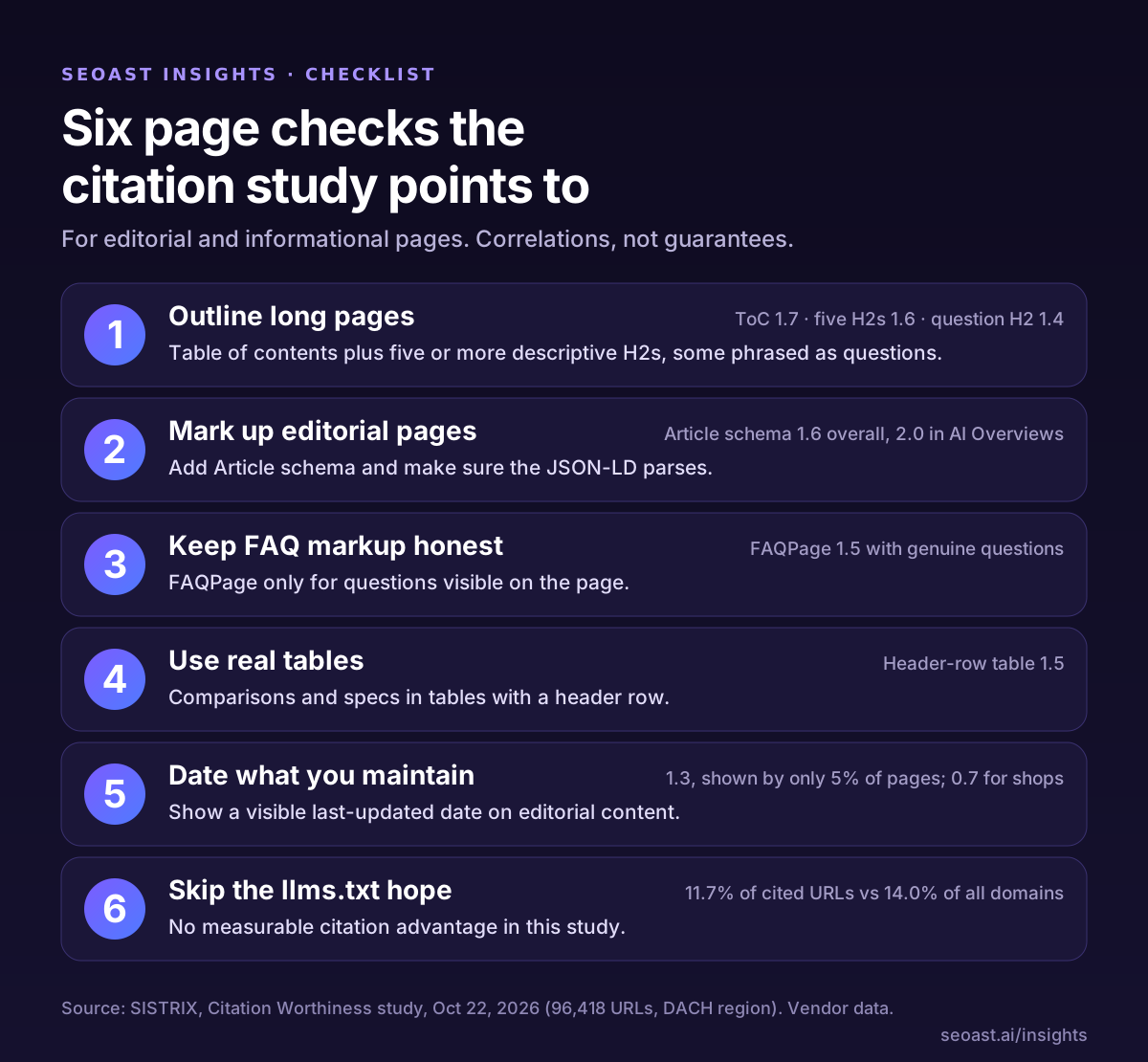
- Give long guides and articles a table of contents and at least five descriptive H2 headings, phrasing some of them as the questions readers ask.
- Add Article or BlogPosting schema to editorial pages, and check that the JSON-LD parses.
- Use FAQPage markup only for questions and answers that are visible on the page.
- Put comparisons and specifications in HTML tables with a header row.
- Show a visible last-updated date on editorial content you maintain.
- Open with a short answer or TL;DR before the detail.
- Do not expect an llms.txt file to change how often you are cited.
What SEOAST checks, and what it does not
SEOAST does not query ChatGPT, Perplexity, Gemini or Google AI Overviews, does not track citations and has no AI visibility score. It cannot tell you whether any answer engine cites your page.
SEOAST audits one URL from its server HTML. Its heading check confirms one H1 and an outline with no skipped levels; it does not count H2s or detect a table of contents. Its structured data check reports whether JSON-LD parses and which @types are present, such as Article or FAQPage, without validating individual properties. Its Q&A check flags FAQPage markup whose questions do not appear in the visible copy, which matches the study’s genuine-questions condition. It reports llms.txt for information only, with no effect on the score, which is consistent with the study finding no advantage. Its readability check flags thin or impenetrable copy; the study found Flesch reading ease alone made no measurable difference to citations, so read that check as a quality floor for human readers.
Questions
What is the SISTRIX citation worthiness study?
A study published by SISTRIX on October 22, 2026 that compared 48,527 pages cited by ChatGPT, Google AI Mode and Google AI Overviews in the DACH region with uncited pages from the same domains, 96,418 URLs in all, across 43 page features.
Does llms.txt help pages get cited by AI?
The SISTRIX study found no measurable advantage: 11.7% of cited URLs came from domains with an llms.txt file, against 14.0% across all domains.
Does schema markup affect AI Overviews citations?
In the study, Article schema had a factor of 2.0 for AI Overviews and FAQPage schema 1.5 overall when the questions were genuine, while Breadcrumb, HowTo and QAPage schema showed no difference. These are correlations, not proof that adding markup causes citations.
How do I make a page easier for AI answers to cite?
The study points to clear structure: a table of contents, descriptive H2s including questions, tables with header rows, a short answer up front, Article schema and a visible update date on editorial pages.
Sources
- Citation Worthiness: Which GEO Tactics Hold Up Across 96,418 URLs — SISTRIX
- Daily Search Forum Recap: October 23, 2026 — Search Engine Roundtable