Insights ·
Google user-generated spam guidance: noindex shared pages by default
The short version
Google updated its user-generated spam guidance on October 26, 2026 to cover tools that let users publish shared pages, generated content or web apps. Its advice is direct: pages made for sharing, collaboration or utility should be kept out of Search by default with a noindex rule or a robots.txt block, and platforms should verify their site in Search Console and watch for spikes in indexed pages. Google’s own wording does not mention AI, but it describes the shareable outputs that page, chat and app builders publish every day. For a site owner, the practical check is whether each page type says what you mean in its robots meta tag, its X-Robots-Tag header and robots.txt.
What changed in Google’s user-generated spam guidance on October 26?
Google Search Central logged the change on October 26, 2026 as “Updated guidance on preventing user-generated spam”. The page, “Prevent user-generated spam on your site and platform”, gained guidance on blocking indexing of link-shared content and on monitoring abuse in Search Console. Google gave the reason in its update log: to help platforms keep user-created pages that are not meant for Search out of the index and to detect spam earlier.
Three things are new. The scope now names hosting platforms and tools that let users publish shared pages, generated content or web apps. A new section, “Only index content meant for Search”, tells those services to decide whether user-created pages should be discoverable in search or reachable only by people who have the link. And a monitoring section explains how to catch abuse before it becomes a manual action.
SEOAST Impact Rating: A2, plan for it. It is a confirmed Google documentation change, but it adds no new spam policy or penalty; the enforcement risk comes from the existing spam policies and manual actions. The Impact Rating is SEOAST’s own editorial rating, not a Google severity level.
Which sites does the updated guidance cover?
Any service where users can create pages that end up on your domain or subdomains: hosting platforms, forums and comment sections, and now, explicitly, tools that publish shareable pages, generated outputs or interactive tools. Google’s text does not use the word AI. Search Engine Journal’s Roger Montti read the update as a sign of wider attention to this kind of spam, while noting that it does not show a crackdown is imminent.
The risk is the same one Google has described for years. Spammers use open platforms to publish many low-value pages under a domain they do not own, and the platform’s search presence pays for it. A share link that is indexable by default turns every user output into a potential search result.
Noindex or robots.txt: which should a shared page use?
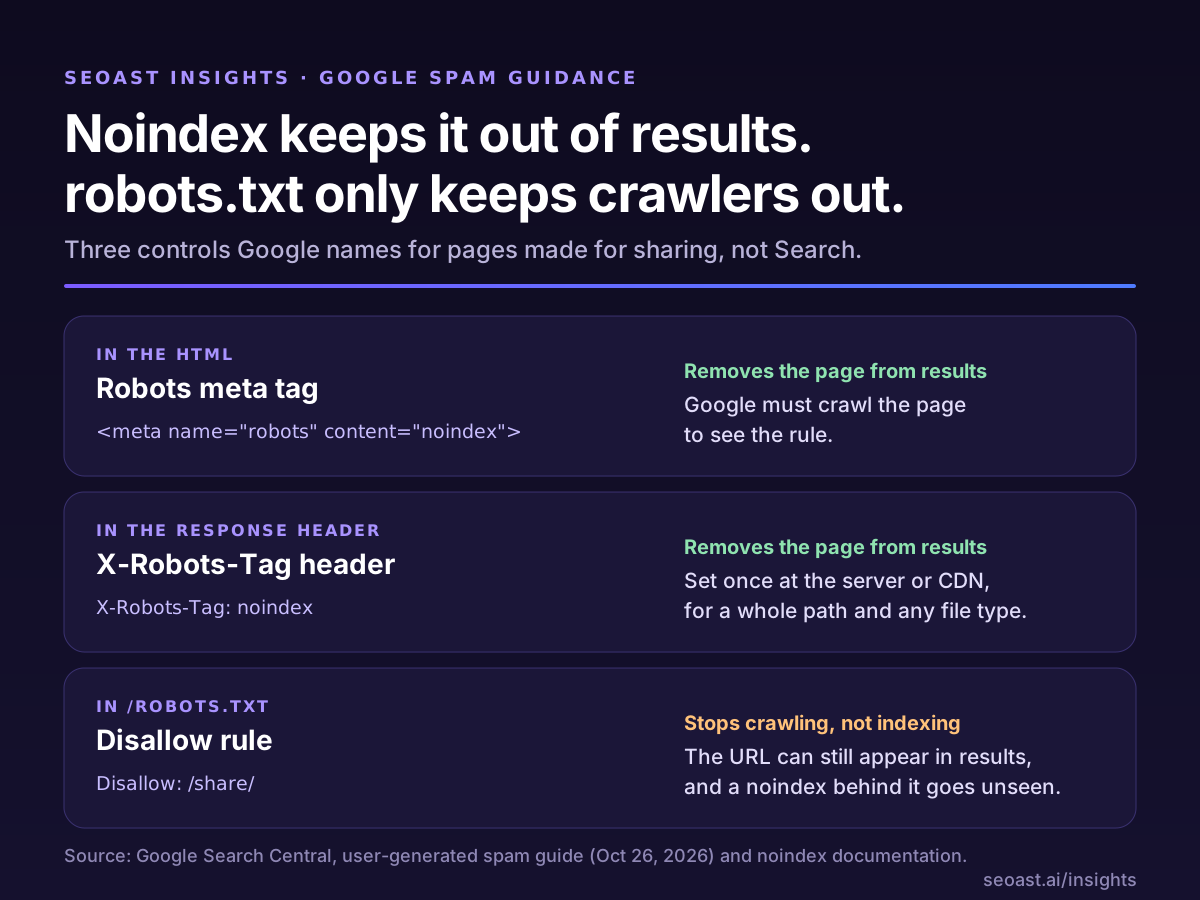
Google lists both. For pages created for direct sharing, collaboration or utility rather than search, it recommends a noindex rule by default, either as a robots meta tag in the HTML or as an X-Robots-Tag HTTP response header, or blocking crawling in robots.txt.
They are not interchangeable. Google’s documentation on blocking indexing says that for noindex to work, the page must not be blocked by robots.txt, because a crawler that cannot fetch the page never sees the rule, and the URL can still appear in search results. A robots.txt block keeps crawlers out; a noindex keeps the page out of results. For share links that might already be indexed, noindex with crawling allowed is the rule that removes them. The X-Robots-Tag header is the easier default for a platform, because it can be set once at the server or CDN for a whole path such as /share/.
How does Google say to monitor abuse in Search Console?
Google asks platforms to verify their site or subdomain in Search Console so they receive email alerts if Google issues a manual action or finds a security issue. It recommends checking the Page Indexing and Search performance reports regularly for unexpected spikes in indexed pages, impressions or queries.
It also suggests tracking creation and indexing at the platform level, with alerts for anomalies such as a sudden rise in new public pages or a small number of users generating a large share of indexable URLs. Those are signals a platform has to build from its own data; Search Console shows the effect, not which accounts caused it.
What to check on your site this week
If users can publish anything on your domain, these checks come straight from Google’s guidance and its indexing documentation.
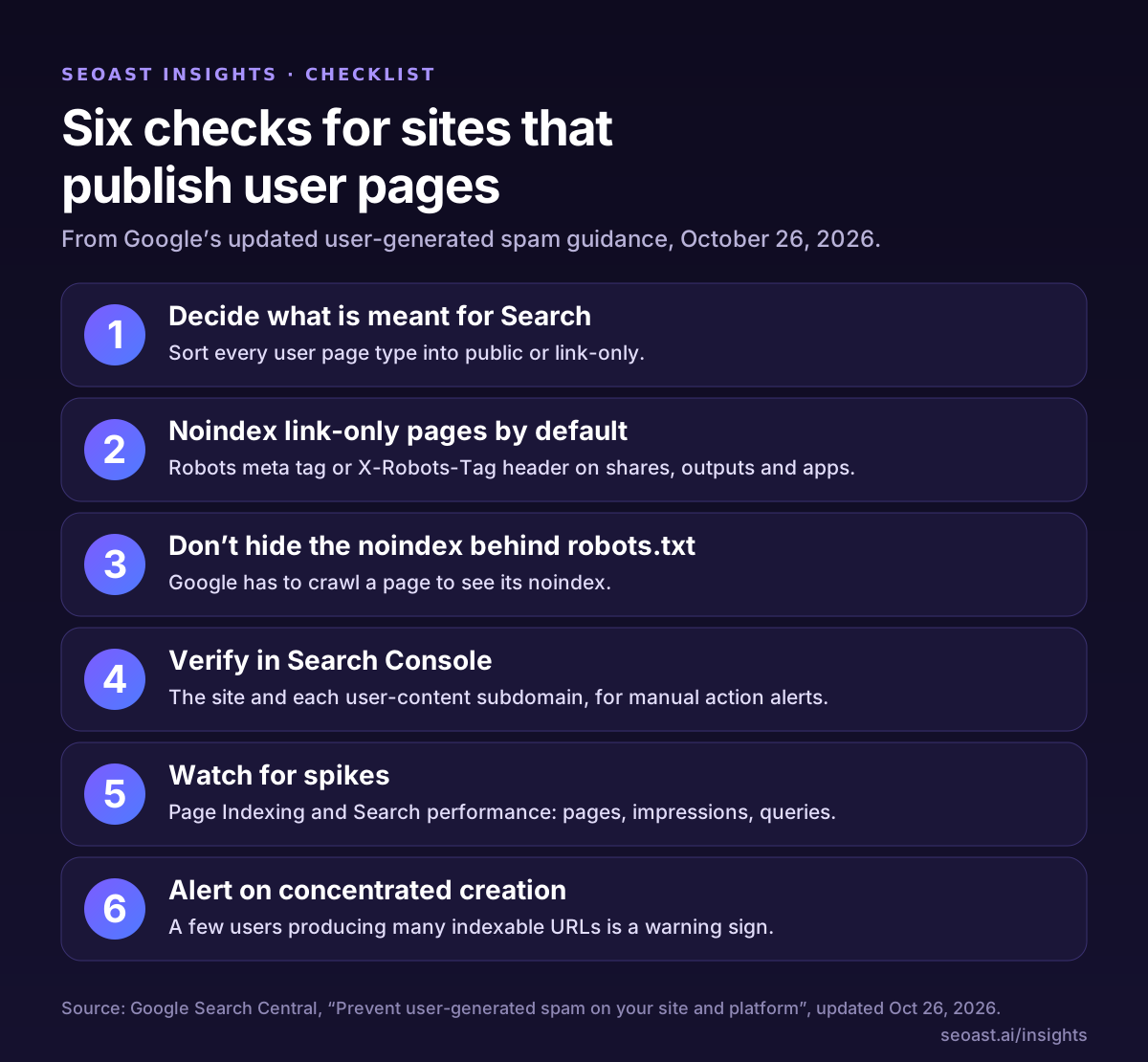
- List every page type users can create and decide which are meant for Search and which are link-only.
- Give link-only page types a noindex rule by default, in the robots meta tag or the X-Robots-Tag header.
- Leave those paths crawlable in robots.txt so Google can see the noindex, especially if some are already indexed.
- Confirm your own public pages do not inherit the noindex by mistake.
- Verify the site and any user-content subdomains in Search Console.
- Watch the Page Indexing and Search performance reports, and alert on spikes in new public pages.
What SEOAST checks, and what it does not
SEOAST audits one URL from its server HTML and response. Its robots meta check reads the robots, googlebot, bingbot and googlebot-news meta tags. Its X-Robots-Tag check reads the response header. Its robots.txt check tests whether the audited path is allowed for Googlebot. A noindex in either the meta tag or the header caps the SEOAST score at 35, and a robots.txt block caps it at 40, because nothing else on the page matters while it is out of search.
Read those rows for what you intend. On a public page, a noindex is the problem. On a link-shared page that should stay out of Search, a noindex is exactly the result you want, and an allowed robots.txt path is what lets Google see it. SEOAST does not crawl your platform, count indexed URLs, read Search Console or detect spam accounts, so audit one example of each page type rather than expecting a site-wide answer.
Questions
What is Google’s user-generated spam guidance?
A Google Search Central page, “Prevent user-generated spam on your site and platform”, that explains how sites with comments, forums, hosting or publishing tools can stop spammers using them. Google updated it on October 26, 2026.
Does the guidance apply to AI page and app builders?
Google’s wording does not mention AI, but it now covers tools that let users publish shared pages, generated content or web apps, which describes many AI page, chat and app builders.
How do I keep link-shared pages out of Google Search?
Google recommends a noindex rule by default, using a robots meta tag or an X-Robots-Tag HTTP header, or a robots.txt block for pages created for sharing, collaboration or utility rather than search.
Does a robots.txt block remove a page from Google?
Not reliably. Google says a page blocked by robots.txt can still appear in search results, and it cannot see a noindex on a page it is not allowed to crawl. Use noindex with crawling allowed to remove a page.
Sources
- Prevent user-generated spam on your site and platform — Google Search Central
- Latest Google Search documentation updates — Google Search Central
- Block Search indexing with noindex — Google Search Central
- Google Signals A Wider Crackdown On SEO Spam — Search Engine Journal
- Google Warns Tools On User-Generated Spam Guidance & More — Search Engine Roundtable