Insights ·
Verify Googlebot with reverse DNS? googleusercontent.com lets fakes pass
The short version
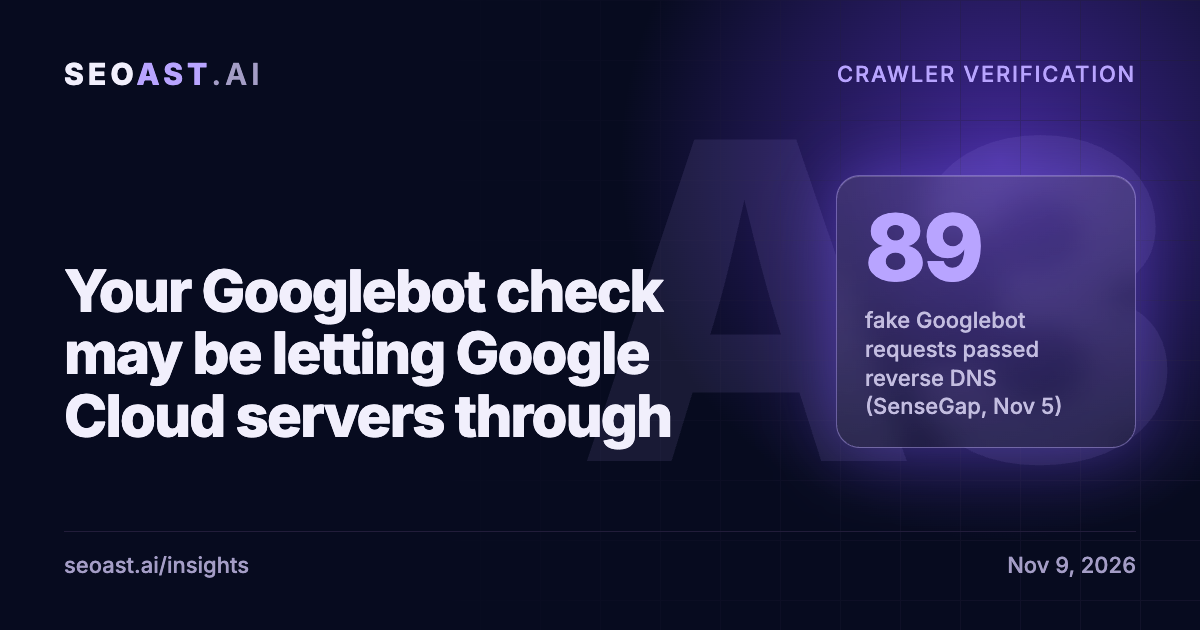
Googlebot reverse DNS verification, done by the letter of Google’s command-line steps, can pass a request from an ordinary Google Cloud server. Step 2 of Google’s method accepts any hostname on googlebot.com, google.com or googleusercontent.com, while Google’s own table says Googlebot resolves to googlebot.com and googleusercontent.com hostnames belong only to user-triggered fetchers. A field report published by the bot-analytics vendor SenseGap on November 5, 2026 says 89 requests from Google Cloud machines claiming to be Googlebot passed that loose check on its sites, most of them probing for secret files. The fix is to match the hostname to the crawler type and check the IP against Google’s per-crawler lists.
How do you verify Googlebot with reverse DNS?
Google’s page “Verify requests from Google crawlers and fetchers” gives two methods. The manual one has three steps: run a reverse DNS lookup on the IP address in your logs; check that the hostname is on googlebot.com, google.com or googleusercontent.com; then run a forward DNS lookup on that hostname to confirm it points back to the same IP. The other method matches the IP address against the ranges Google publishes for each kind of crawler.
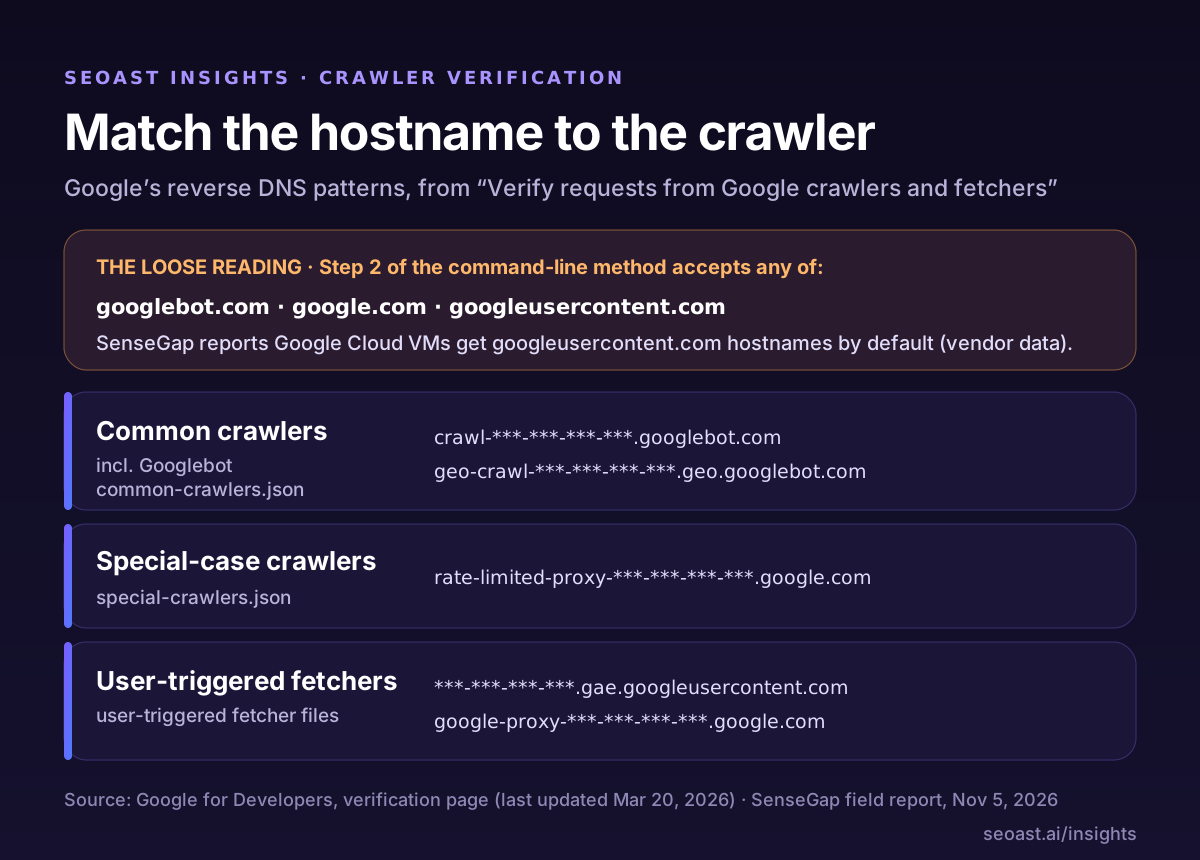
Further down, the same page lists which hostname pattern belongs to which crawler type. Common crawlers, which include Googlebot, resolve to crawl-***.googlebot.com or geo-crawl-***.geo.googlebot.com. Special-case crawlers resolve to rate-limited-proxy-***.google.com. User-triggered fetchers resolve to ***.gae.googleusercontent.com or google-proxy-***.google.com. So by Google’s own table, a googleusercontent.com hostname is only ever valid for a user-triggered fetcher, and only on gae.googleusercontent.com.
Why googleusercontent.com is not proof of Googlebot
On November 5, 2026, SenseGap, which sells bot tracking and verification, published a field report from four of its own sites over eight days (October 28 to November 5). It says Google Cloud virtual machines get googleusercontent.com hostnames by default, so a rented server that sends the Googlebot user agent passes step 2 as written. Its own verifier followed that wording and was fooled; it says it fixed the verifier the same day.
In its data, 89 requests from Google Cloud machines claimed to be Googlebot and passed the loose check. The report says about two-thirds of the fake requests it found were looking for secrets such as .env files and credentials, not crawling pages. It calls itself “a field report, not a survey of the web”, and the numbers come from Cloudflare’s sampled analytics, so treat them as vendor data from a small sample.
SEOAST Impact Rating: A3, good to know. Google has not changed anything; this is a vendor report on how its documented steps can be read too loosely. The Impact Rating is SEOAST’s own editorial rating, not a Google severity level.
Does fake Googlebot traffic matter for robots.txt and AI crawlers?
Robots.txt only binds crawlers that choose to follow it. An impostor that sends the Googlebot user agent is not reading your Googlebot rules; it is borrowing the name because many sites wave Googlebot through. On October 30, Search Engine Roundtable reported Google’s Gary Illyes saying bot impersonation has grown and linking it to AI, because “you can say you are Googlebot and they will let you in.”
The SenseGap report says the same scanner addresses also used AI crawler names, with the fake share varying widely by name. It also notes that some AI crawlers publish no IP or DNS data to check against, so their visits can only be counted as unverified, not as real or fake.
The practical risk runs both ways. A loose check lets scanners past rules meant for Google. A firewall that blocks everything claiming to be Googlebot from a cloud range can also block real Google fetchers, because Google’s user-triggered fetchers do use gae.googleusercontent.com hostnames.
How to verify Googlebot correctly: four checks
These follow from Google’s verification page and its per-crawler IP range files.
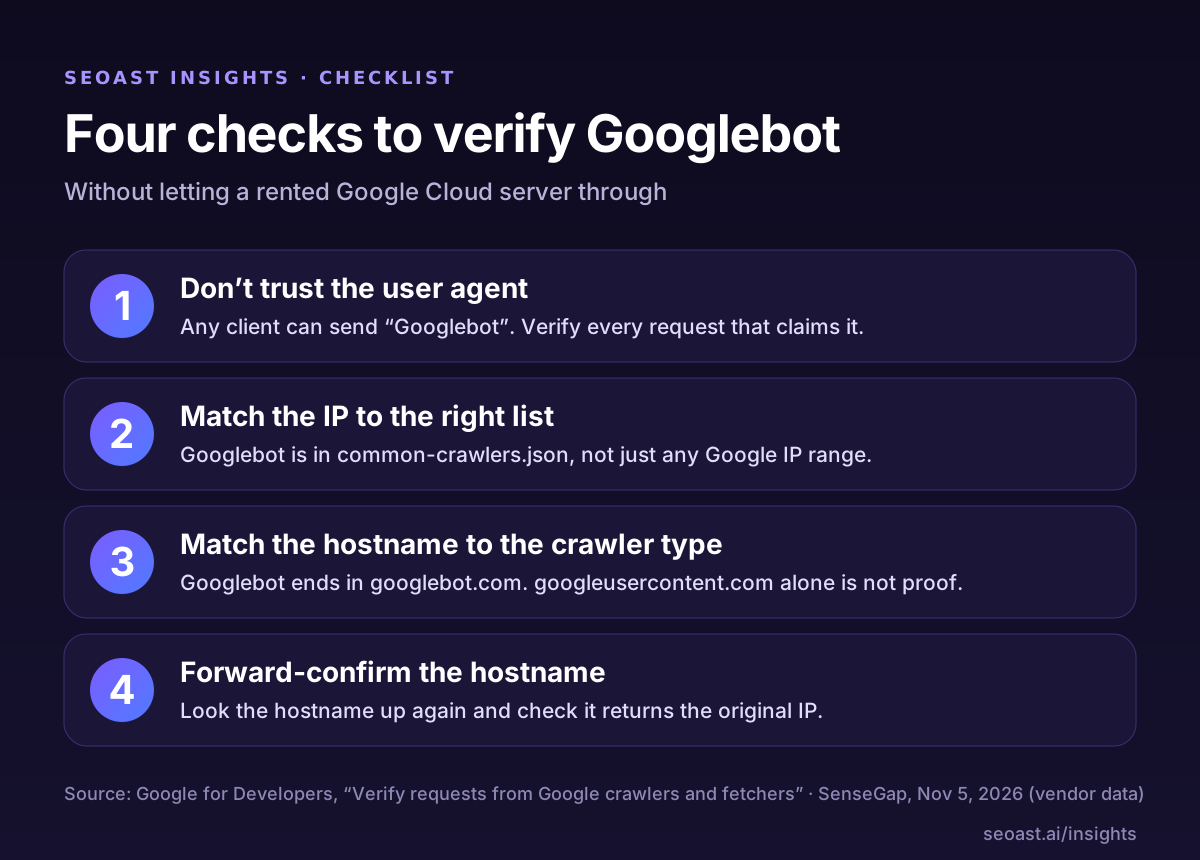
- Never trust the user-agent string alone; any client can send “Googlebot”.
- Match the IP address to the right list: common-crawlers.json for Googlebot, special-crawlers.json and the user-triggered fetcher files for the others.
- Match the reverse DNS hostname to the crawler type: Googlebot should end in googlebot.com, and a googleusercontent.com hostname should be accepted only as a user-triggered fetcher on gae.googleusercontent.com.
- Run the forward DNS lookup and confirm it returns the original IP, then re-check any verifier, WAF rule or log script that accepts the three domains as one list.
What SEOAST checks, and what it does not
SEOAST audits one URL from its server HTML. Its robots.txt check tests whether the audited path is open to Googlebot, and its scored ai_crawler_access check tests whether robots.txt lets the answer-engine crawlers OAI-SearchBot, ChatGPT-User, Claude-SearchBot and PerplexityBot read the site root and the audited path. Those checks read your rules; they say nothing about who actually obeys them.
SEOAST does not read your server logs, does not verify crawler IP addresses or reverse DNS and does not see your firewall or CDN bot rules. It does not query ChatGPT, Perplexity, Gemini or Google AI Overviews, does not track citations and does not read your analytics.
Questions
How do I verify Googlebot with reverse DNS?
Run a reverse DNS lookup on the IP, check that the hostname matches the crawler type (Googlebot ends in googlebot.com), then run a forward DNS lookup and confirm it returns the same IP.
Is googleusercontent.com a valid Googlebot hostname?
Not for Googlebot. Google’s table lists googleusercontent.com hostnames, on gae.googleusercontent.com, only for user-triggered fetchers. Step 2 of its manual method accepts the domain more broadly.
Can a Google Cloud server pretend to be Googlebot?
A November 5, 2026 SenseGap field report says yes, against a check that accepts any googleusercontent.com hostname. Matching the hostname to the crawler type and checking Google’s IP lists closes that gap.
Does blocking fake Googlebots affect my Google rankings?
Blocking requests that fail verification does not block Google. Blocking by user agent or by cloud IP range alone can block real Google fetchers, so verify before you block.
Sources
- Verify requests from Google crawlers and fetchers — Google for Developers
- Google’s reverse DNS steps let any Google Cloud server pass as Googlebot — SenseGap
- Daily Search Forum Recap: November 6, 2026 — Search Engine Roundtable
- Google’s Gary Illyes: AI Made Bot Impersonation Worse — Search Engine Roundtable